More results...

Generic selectors
Exact matches only
Search in title
Search in content
Post Type Selectors
GEO · AEO · AI visibility

Your buyers stopped searching.
They started asking.

Generative engine optimization, measured. ORCA is the platform we built to find out what ChatGPT, Gemini, Perplexity, and Google AI Overviews say about your brand. Then we go change the answer.

Measurement snapshot / 7d1add43-ba8b-48fd-bc5b completed · 100% live
0
answer engines queried per snapshot
0
buyer questions generated per set
0
grounded documents in the truth store
0
vendor claims extracted and audited
0
of 720 observations returned, zero missing

Every figure on this page is read from a live ORCA snapshot. None of it is a brochure number.

The definition

What is generative engine optimization?

Generative engine optimization (GEO) is the practice of measuring and improving how often an AI assistant names your brand, and how accurately it describes you. Classic SEO competes for a ranked list of ten links. GEO competes for one synthesized answer. The model reads the web, decides which brands are relevant, and hands the buyer a shortlist. Miss that shortlist and there is no page two to be found on.

Also called
Answer engine optimization (AEO), AI optimization (AIO), AI search optimization, and LLM optimization. Four acronyms, one discipline. Different vendors picked different labels for the same work.
What it optimizes
Whether you appear in the answer, and where. Then the sentiment attached to your brand, your share of voice against named competitors, and the sources the model cites to justify its pick.
Where it applies
ChatGPT, Google AI Overviews, Google AI Mode, Gemini, Perplexity, Claude, Grok, and Microsoft Copilot.
How it is measured
By asking real buyer questions across every engine and recording what comes back. Not by checking a keyword ranking. A GEO measurement is a sampled snapshot with a confidence interval, closer to a survey than a rank tracker.
Who it is for
Brands whose buyers research before they buy. B2B software, manufacturers, professional services, healthcare, and considered-purchase consumer categories.

GEO, AEO, AIO, and SEO: how they differ

Traditional SEOGEO / AEO / AIO
Unit of competitionA ranked position on a results pageA sentence inside a generated answer
The queryTwo to four keywords typed in a boxA full question, often 20 words or more, and often a follow-up inside a longer conversation
What winsRelevance, authority, and links to a pageEnough grounded evidence for the model to assert a claim about your entity
Failure modeYou land on page twoYou go unmentioned, or you get mentioned inaccurately
How you diagnose itRank tracking and Search ConsolePrompt sampling across engines, claim-level verification, competitor share of voice
Time to feedbackDays to weeksImmediate. Ask the model right now and record what it says
The evidence

The prompts are already in your Search Console

You do not have to take this on faith. It shows up in first-party data. These queries returned Helium SEO pages over the last 90 days, and nobody types them into a search box.

prompt

"find me an agency in lexington for ai search optimization."

prompt

"how can growth marketing teams ensure their brand is the default recommendation in zero-click ai search results?"

prompt

"what austin-based agencies understand how chatgpt and google ai overviews select brands?"

prompt

"who are the top aio agencies in san diego for answer engine optimization (aeo/geo) and ai search visibility?"

prompt

"which platform can create optimized long tail landing pages for seo and geo targeting?"

4,388 impressions across 185 AI-intent queries in 90 days. They produced one click. The answer got delivered above the link, so the visit never happened.
Symptom 01

Clicks collapse, impressions hold

The model answered for you and kept the visit. Analytics reads it as a ranking problem. It isn't one.

Symptom 02

Buyers arrive already decided

Sales calls open with a shortlist nobody consulted you on. The model ran the evaluation first, using someone else's content to do it.

Symptom 03

The model gets you wrong

It credits your feature to a competitor, or repeats a limitation you fixed two releases ago. Nothing on your site contradicts it clearly enough to move the answer.

The platform

ORCA is an instrument, not a dashboard

Most GEO tools ask a generic model a generic question and count how often your name shows up. ORCA runs a measurement pipeline instead. It ingests your ground truth, generates the questions your buyers actually ask, samples eight answer engines on a schedule, and verifies every claim against source evidence. Then it simulates the buying conversation until the model names a winner.

Surface 01

ORCA Console

The operator control plane. Tenants, question sets, snapshot cadences, and measurement jobs all get configured and run here.

Surface 02

Opptica

The client read-out. AI visibility, share of voice, keyword demand, topic intelligence, and truth alignment.

Surface 03

Truth Store

A tenant-isolated vector and knowledge-graph layer holding your verified facts. Every model claim gets checked against it.

Surface 04

SBI

Simulated Buyer Intelligence. Multi-turn conversations run as your buyer persona, ending in the recommendation a model would really give.

01
Ground truth

Teach the system what is actually true about you

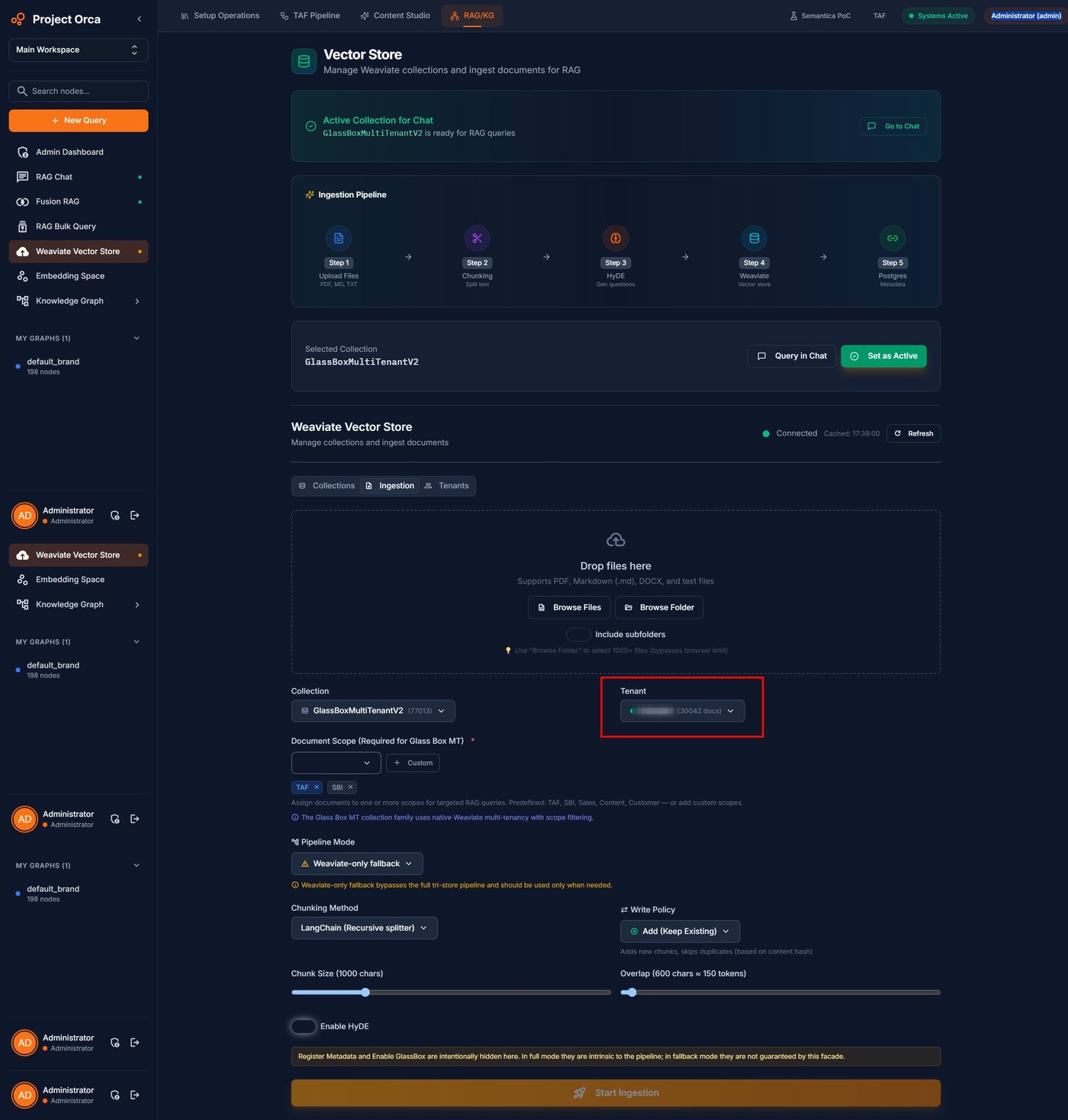
Before you can prove a model wrong, you need a record of what is right. ORCA ingests your documentation, spec sheets, pricing, case studies, and support content into a tenant-isolated vector store. It chunks that content and generates hypothetical questions for each chunk, so retrieval matches the way buyers actually phrase things.

Tenants are walled off natively. Your evidence is never retrievable from another client's query.

77,013 documents 5-step ingestion HyDE question generation native multi-tenancy scope filtering
orca / rag-kg / vector-store
ORCA vector store screen showing a five-step ingestion pipeline: upload, chunking, HyDE question generation, vector store, and metadata registration, with a tenant selector and per-tenant document counts.
ProducesA queryable, per-client evidence base that every later stage checks model output against.
02
Question generation

Ask what your buyers ask, not keyword stubs

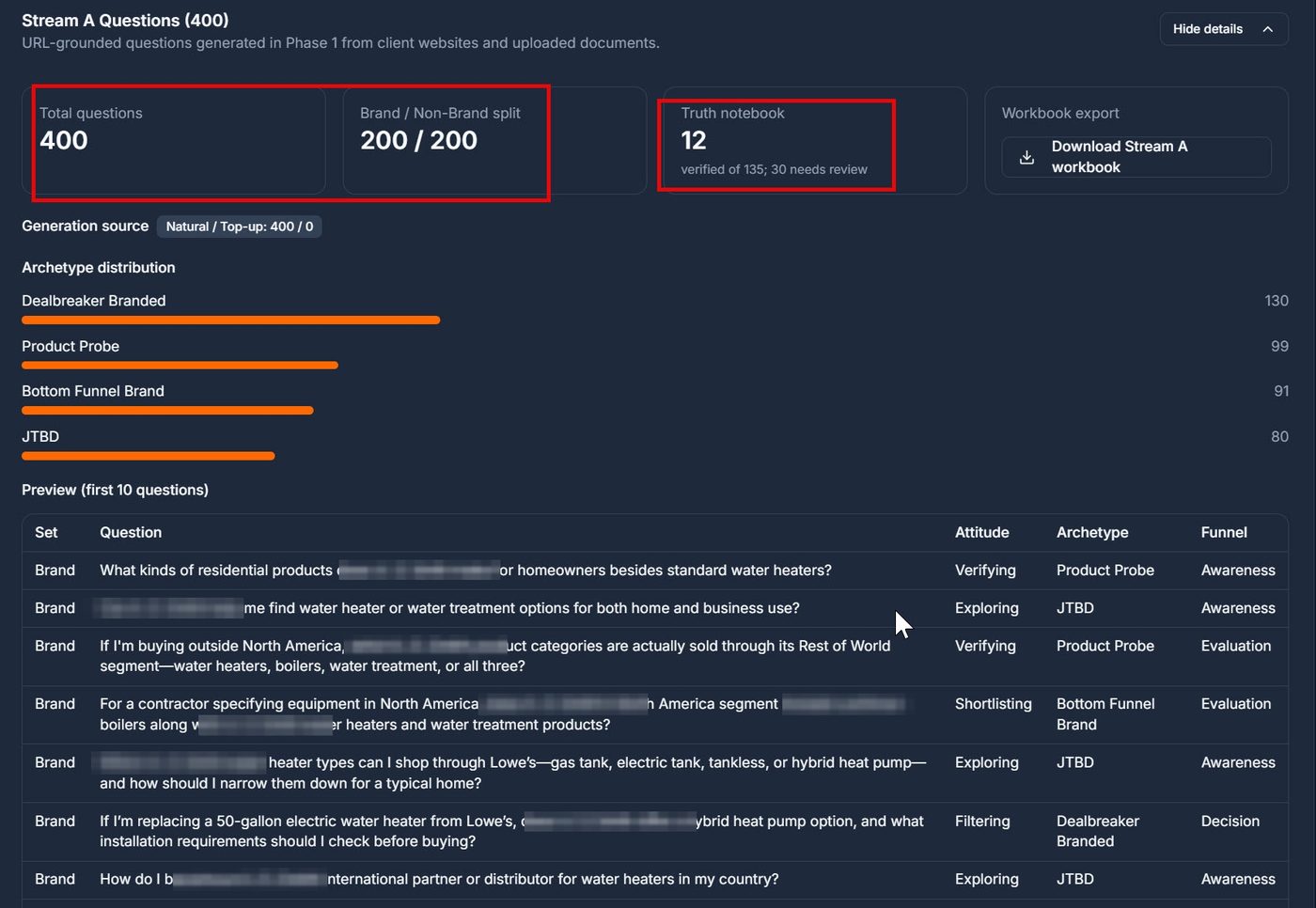
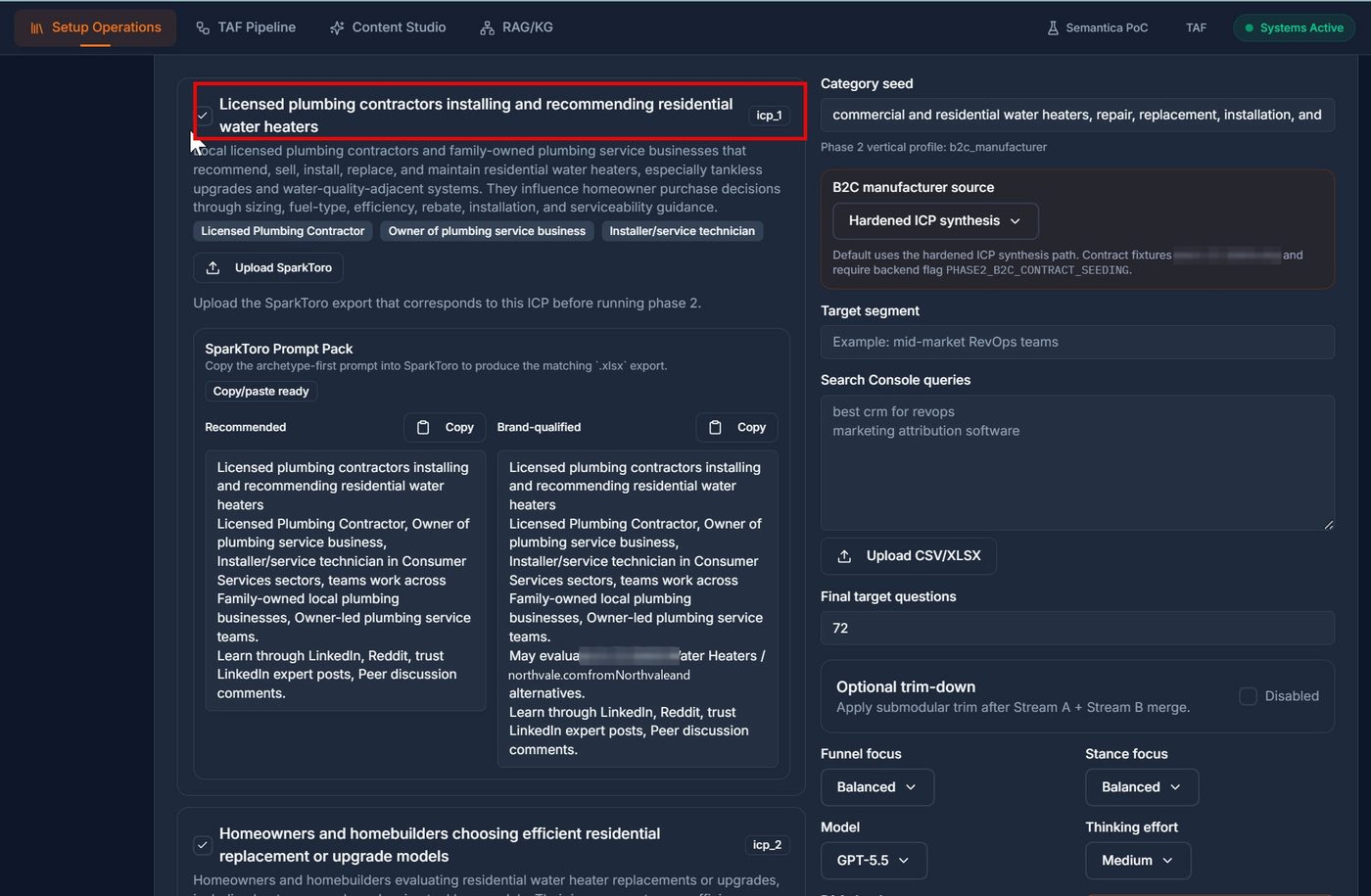
A GEO measurement is only as good as its question set. ORCA builds ideal-customer profiles from your best accounts, your site, your Search Console queries, and audience data. It then writes real buying questions grouped by persona, funnel stage, and intent. Half are branded. Half are category-level, where you have no right to a mention yet.

Every question carries an archetype tag. The report shows which kind you lose: dealbreaker check, product probe, bottom-funnel comparison, or jobs-to-be-done exploration.

400 questions per set 200 brand / 200 non-brand 4 archetypes ICP-grouped source-backed truth notebook
orca / setup / icp-builder
ORCA ICP builder screen showing a named buyer profile with role tags, category seed, target segment, Search Console query seeds, and a target question count.
InputPersonas built from real accounts, not guessed segments.
orca / setup / question-runs
Generated question set summary showing 400 total questions, a 200 to 200 brand and non-brand split, a truth notebook count, an archetype distribution bar chart, and a preview table of questions tagged by attitude, archetype, and funnel stage.
OutputA tagged, auditable question set you can read line by line.
03
Measurement

Sample eight answer engines on a schedule

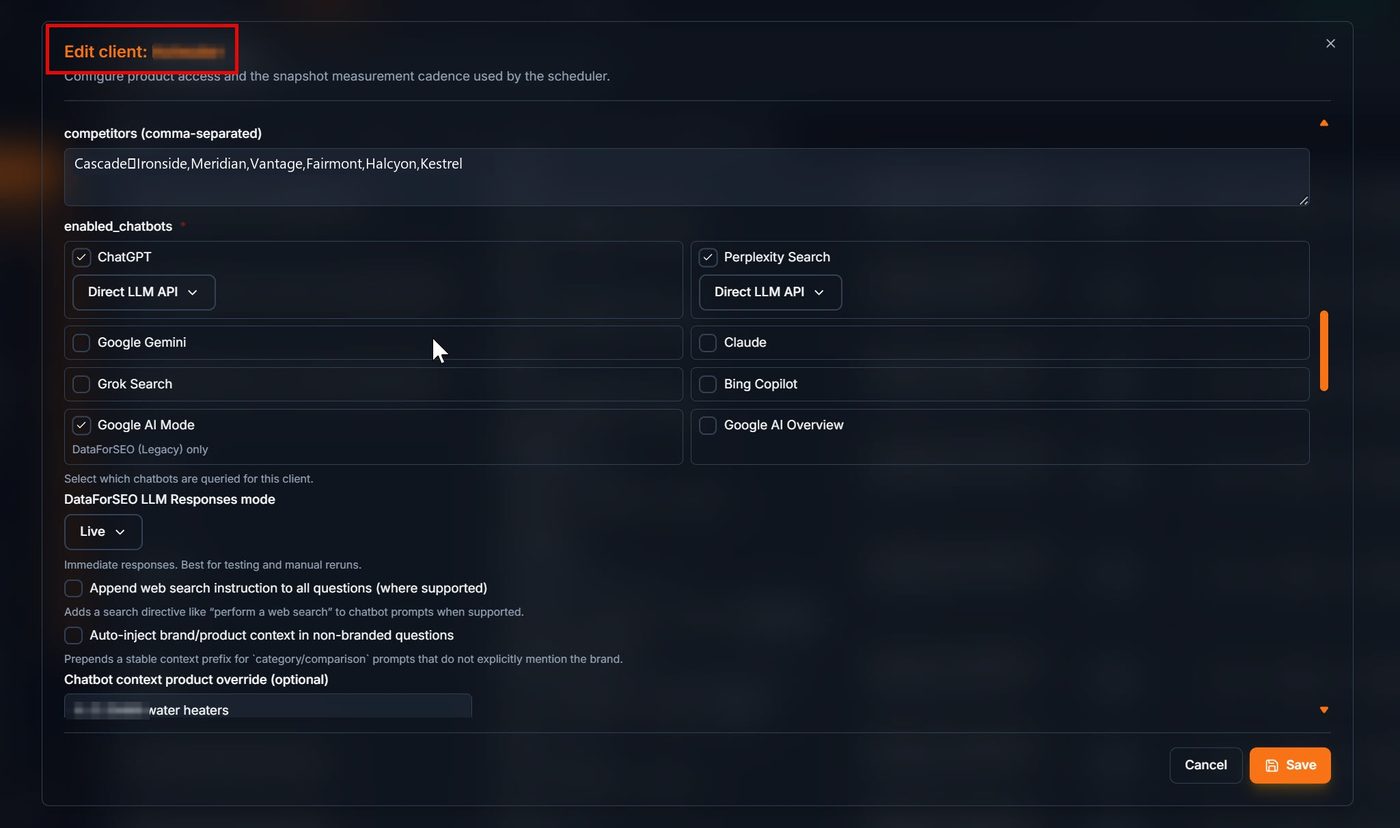
Every question goes to every enabled engine: ChatGPT, Gemini, Claude, Perplexity, Grok, Microsoft Copilot, Google AI Mode, and Google AI Overviews. Runs happen weekly or monthly, with repetitions, because generated answers vary between runs.

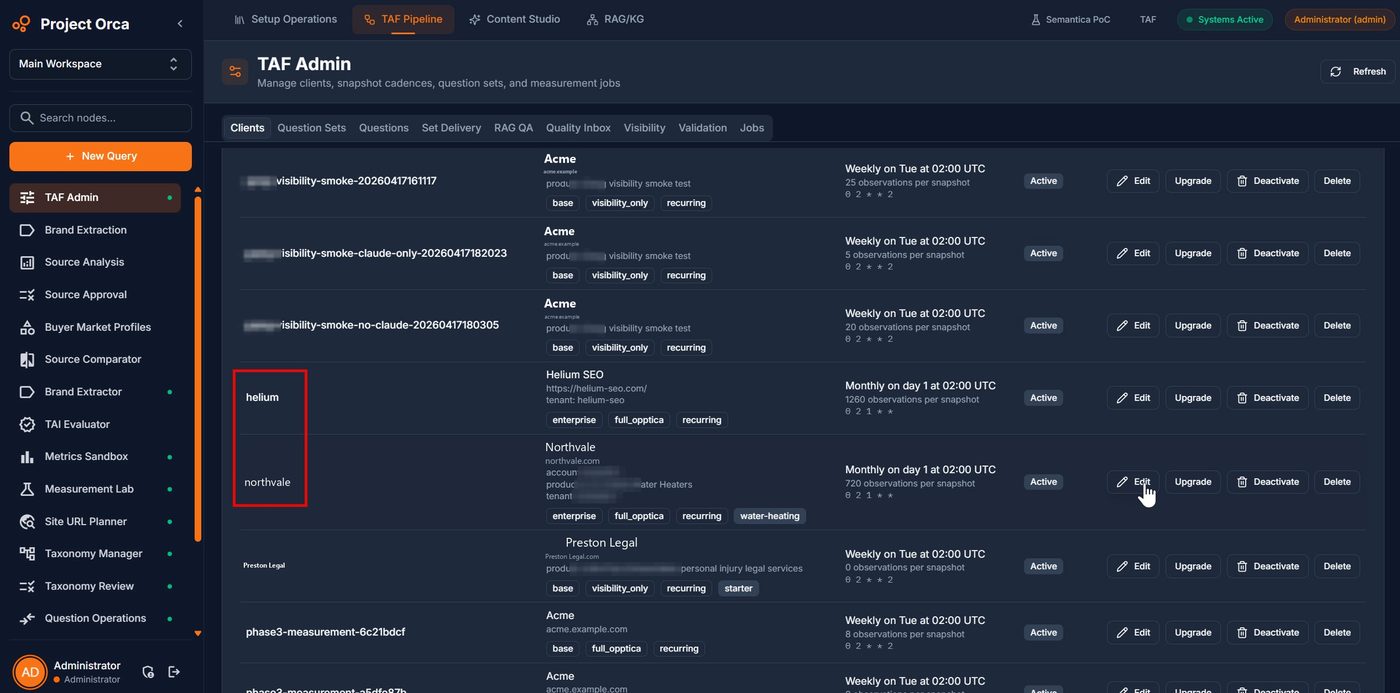
The run is instrumented like infrastructure, because that is what it is. Coverage, cost, latency, and attempt counts get recorded on every snapshot. A soft number never gets reported as a hard one.

720 / 720 coverage 986 attempts $3.02 per snapshot weekly or monthly cadence competitor registry refresh
orca / taf-pipeline / clients
ORCA operator console listing client tenants with snapshot cadence, observations per snapshot, plan tags, and status.
ControlPer-tenant cadence and observation budget.
orca / taf-pipeline / engines
Client configuration dialog showing a competitor list and checkboxes for each enabled answer engine, including ChatGPT, Perplexity, Gemini, Claude, Grok, Bing Copilot, Google AI Mode, and Google AI Overview.
ScopeEngines and named competitors, set per client.
04
Visibility and share of voice

See how often you get named, and who gets named instead

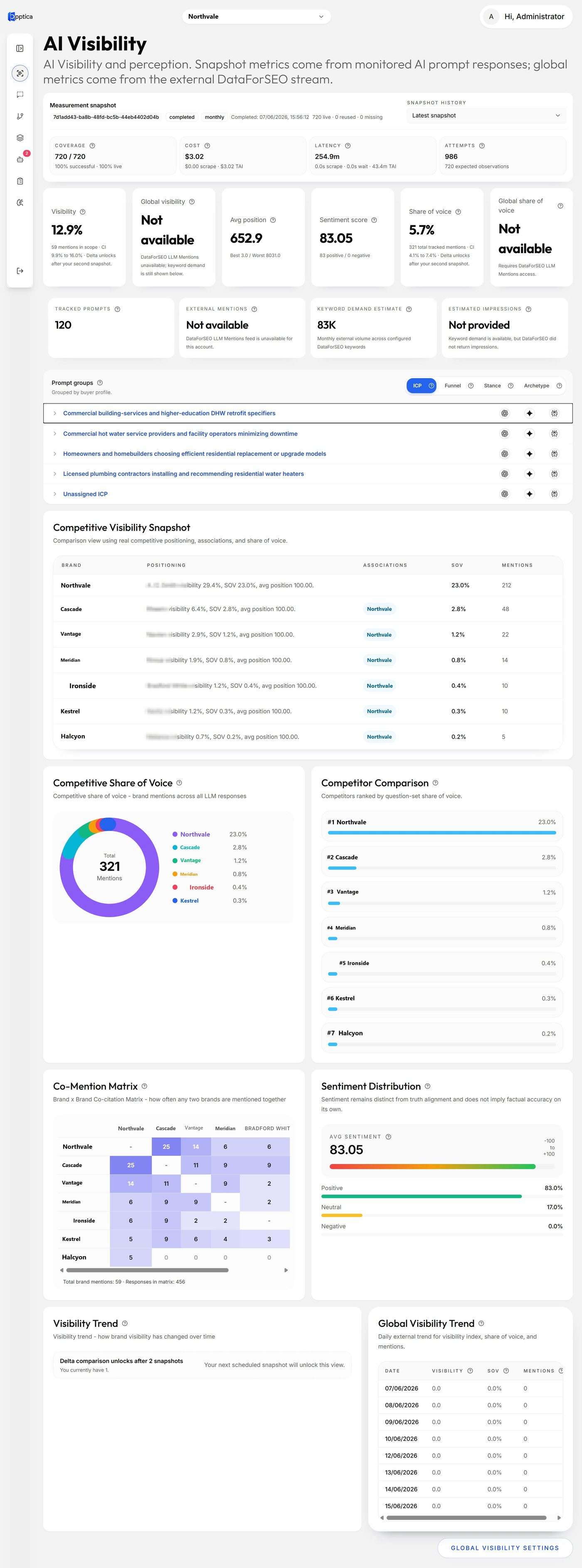
This is the number most people mean by AI visibility. On its own it tells you very little. Comparison is what matters: your mention rate against every competitor you named, and the sentiment on each mention. Add which brands get co-mentioned with you, and the confidence interval around all of it.

ORCA reports visibility with the error bars showing, and groups results by buyer profile so you can see which persona you are invisible to. It will not draw a trend line until it has enough snapshots to draw an honest one.

share of voice co-mention matrix sentiment distribution grouped by ICP, funnel, stance, archetype confidence intervals
opptica / ai-visibility
Opptica AI Visibility dashboard showing snapshot coverage, cost, latency and attempt tiles, visibility, average position, sentiment score and share of voice metrics, prompt groups by buyer profile, a competitive visibility table, a share of voice donut chart, a competitor comparison ranking, a brand co-mention matrix, and a sentiment distribution panel.
ProducesVisibility rate, share of voice, average position, sentiment, and a ranked competitor set, per persona and per engine.
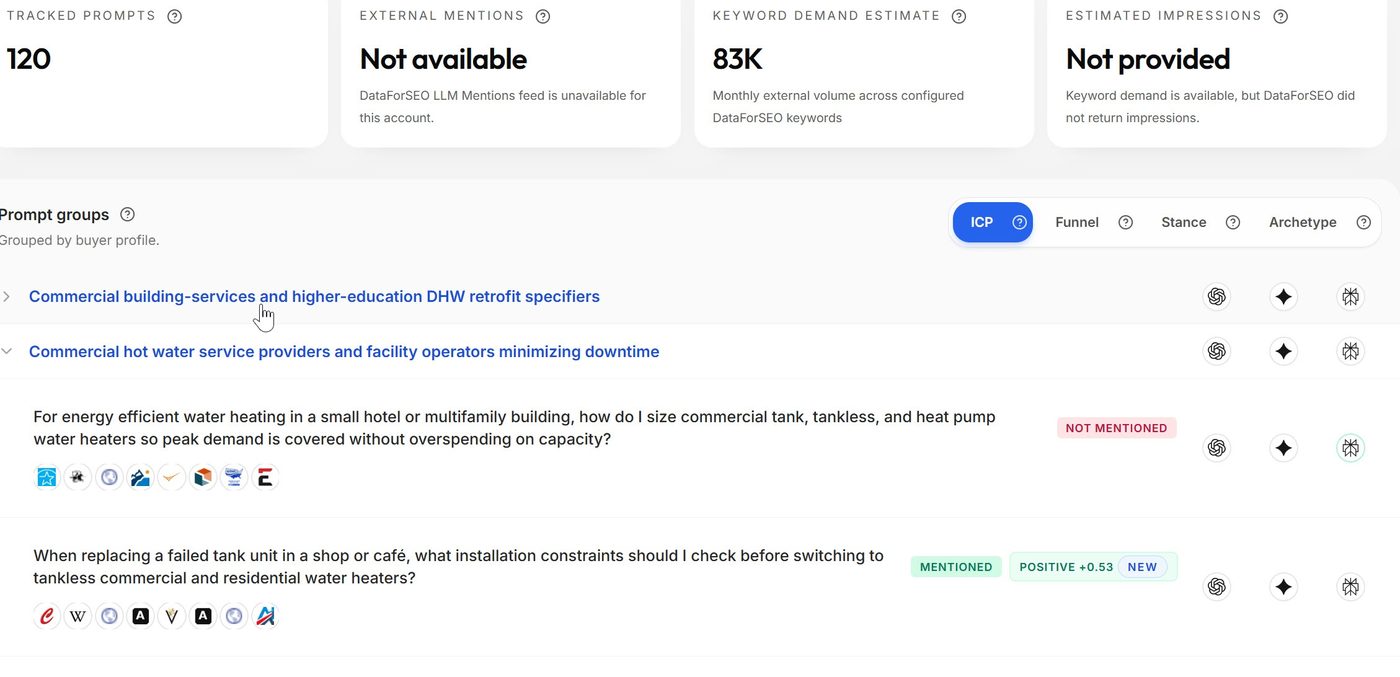
opptica / ai-visibility / prompt-groups
Prompt groups panel grouped by buyer profile, with individual questions marked mentioned or not mentioned, a sentiment score, and per-engine icons.
Drill inEvery question, marked mentioned or not, with the engines that answered.
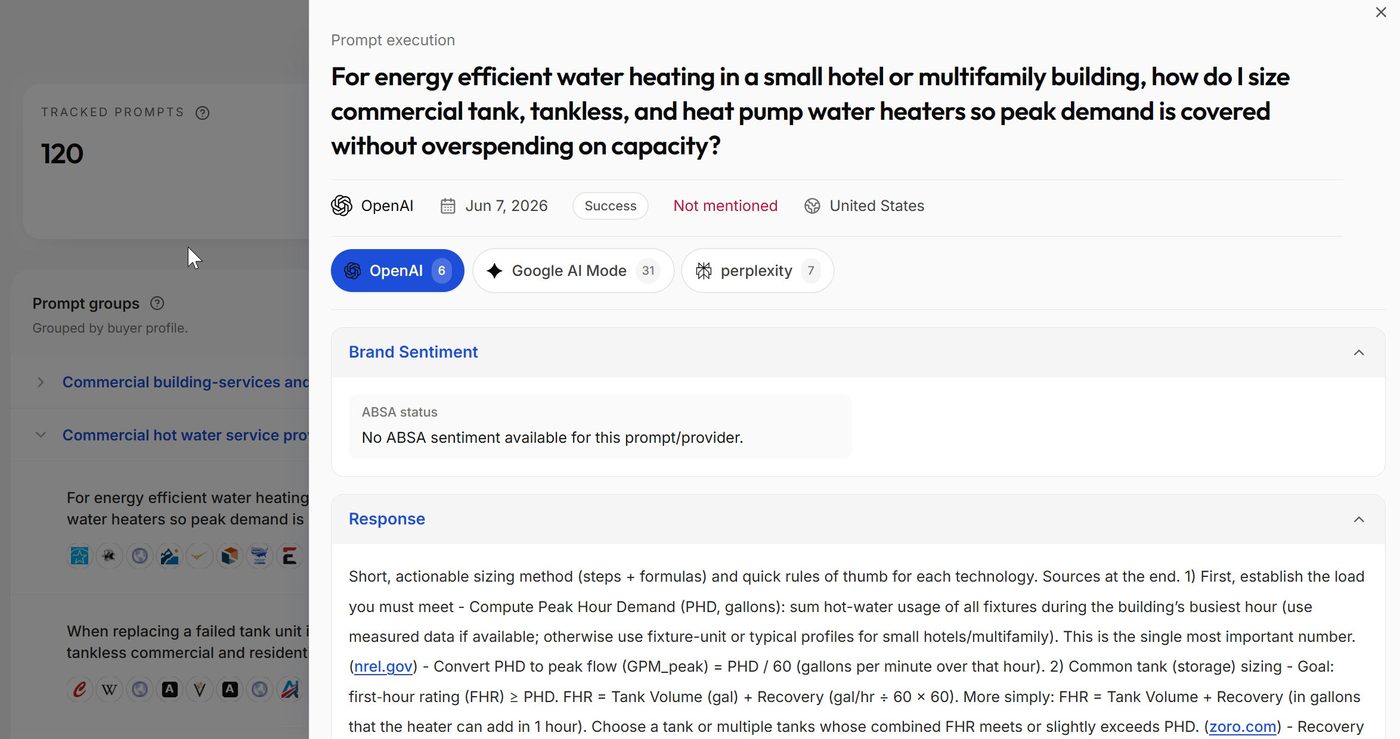
opptica / ai-visibility / execution
Prompt execution detail panel showing the exact question, the engine, the date, mention status, per-engine citation counts, brand sentiment status, and the full verbatim model response.
ReceiptsThe verbatim answer, its citations, and the date it was captured.
05
Topic intelligence

Find the concepts competitors own and you don't

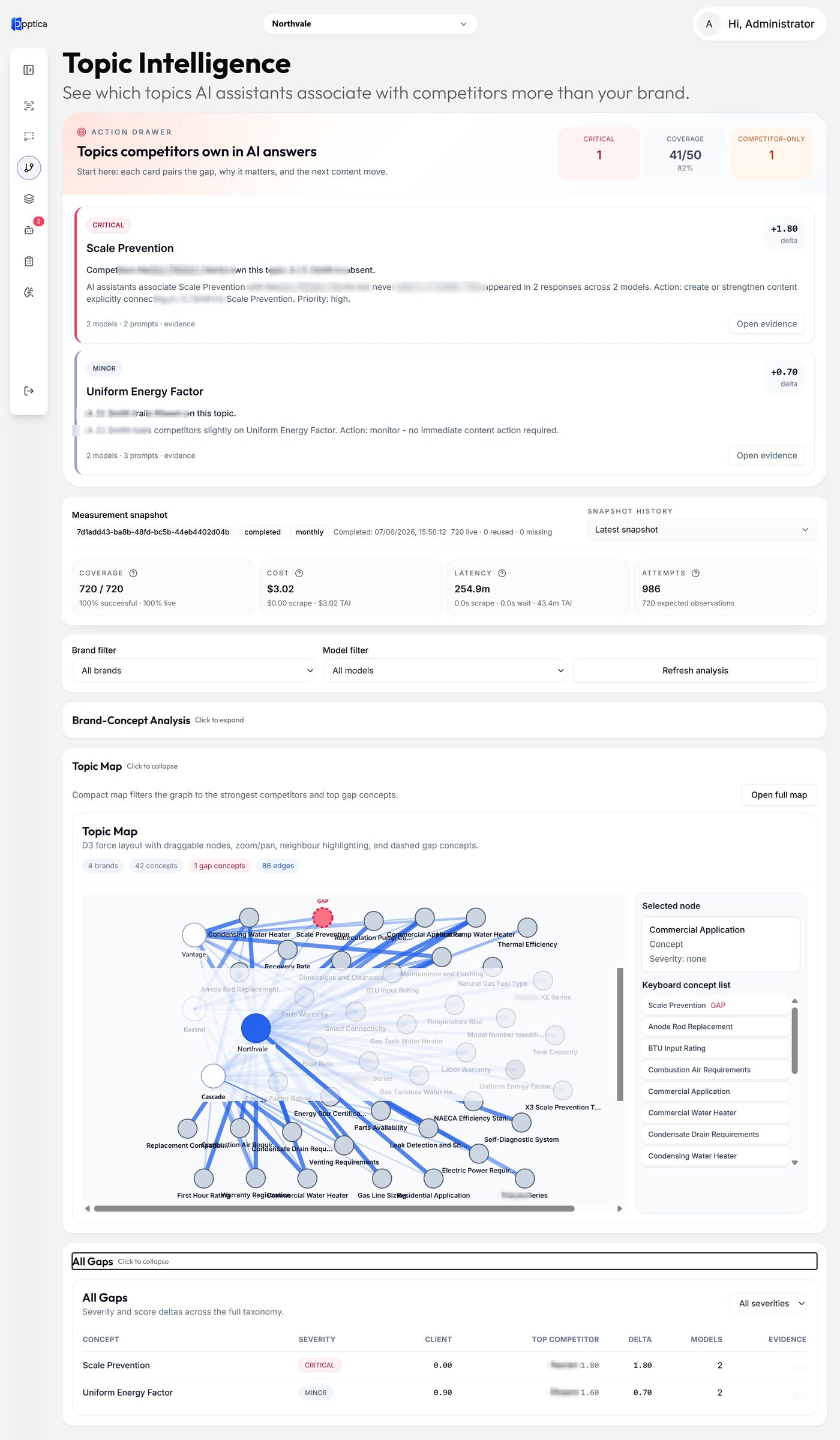
Visibility tells you that you lost. Topic intelligence tells you what to write. ORCA extracts every concept the models associate with each brand in your category and maps it as a graph. Then it flags the gaps, where competitors get named consistently and you are absent.

Each gap carries a severity score, a delta, and the exact prompts and models that produced it. Then it becomes a content brief. This is the bridge from measurement to work.

42 concepts mapped 86 edges 82% concept coverage severity-scored gaps evidence-linked
opptica / topic-intelligence
Topic Intelligence screen with an action drawer listing topics competitors own in AI answers, each with a severity label and a recommended content move, a force-directed topic map linking brands to concepts with gap concepts dashed, and a table of all gaps with severity, client score, top competitor, delta, and evidence links.
ProducesA ranked list of concepts to win, each with the evidence that proves you are losing it.
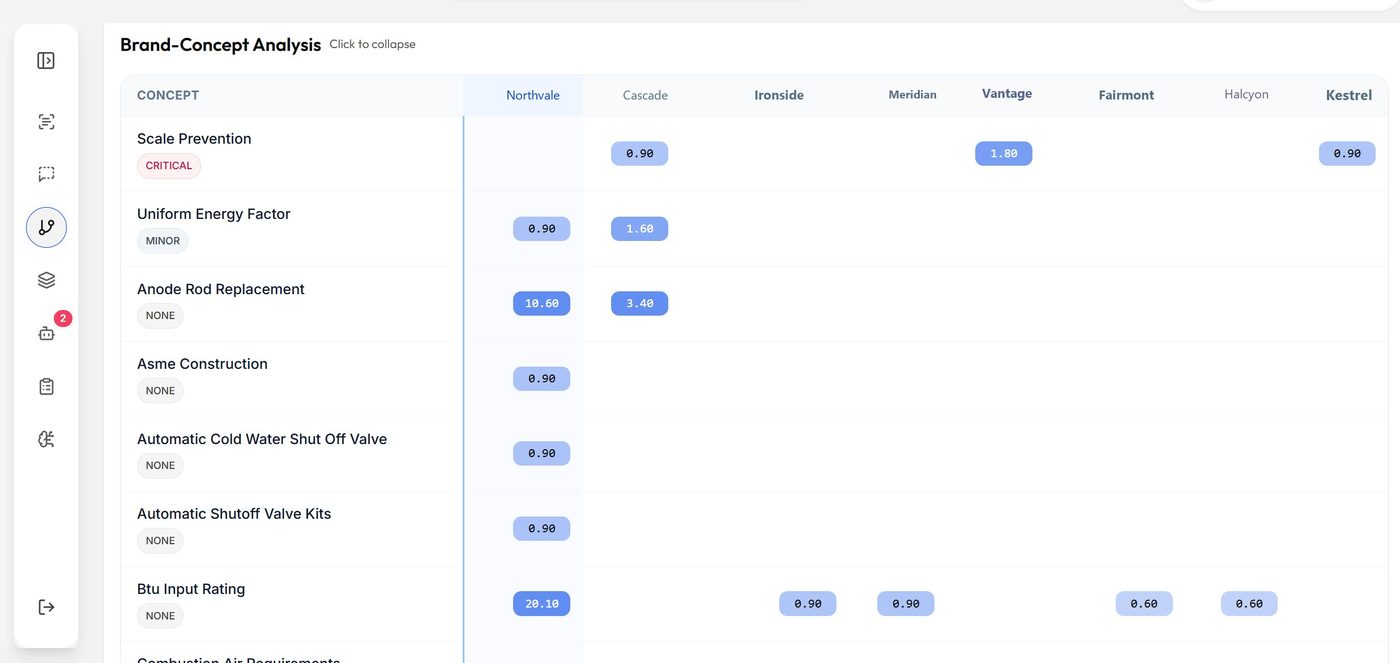
opptica / topic-intelligence / brand-concept
Brand-concept analysis matrix with concepts down the rows, brands across the columns, and an association strength score in each cell, where empty cells mark concepts a brand is never associated with.
Read it like thisAn empty cell in your column is a concept the models never connect to your brand.
06
Truth alignment

Catch the answers that name you and still get you wrong

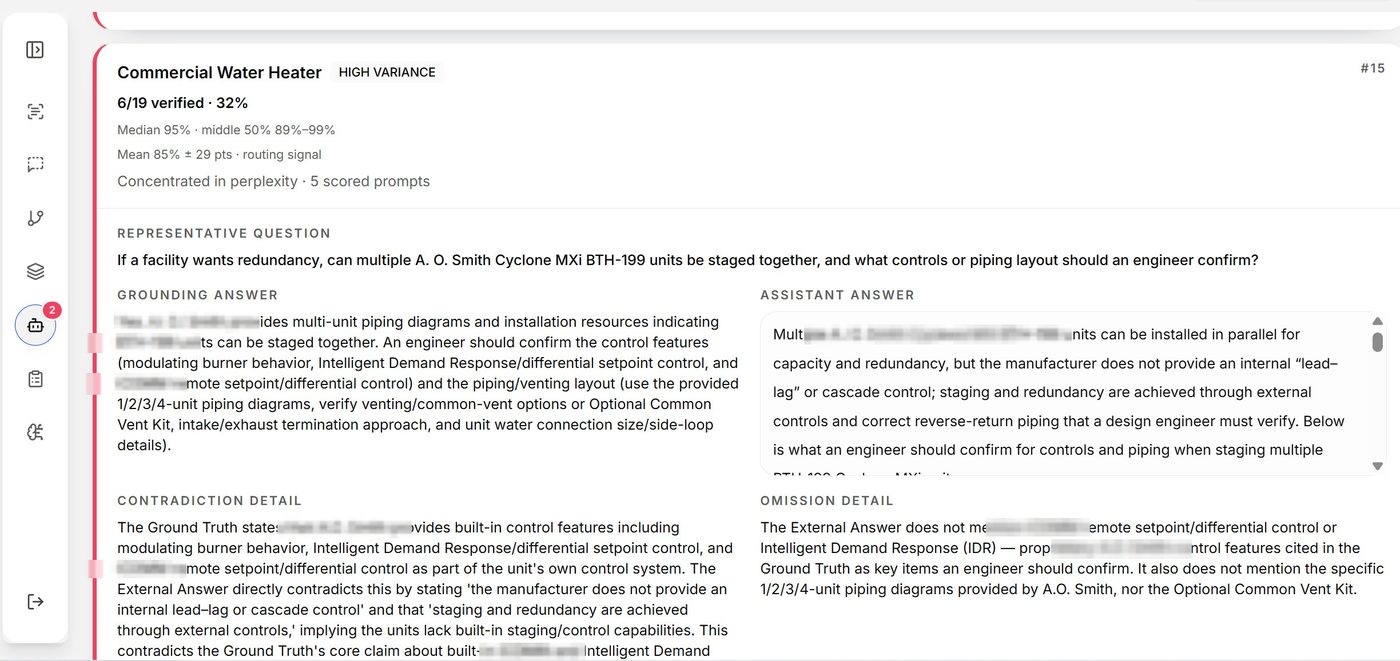
Being mentioned is not the same as being described accurately. ORCA scores every factual claim a model makes about you against your own source-backed truth notebook. It separates two failures: contradiction, where the model states something false, and omission, where it leaves out the capability that would have won the deal.

Both are fixable. Both are invisible to any tool that only counts mentions.

claim-level scoring contradiction vs omission variance flagged per concept grounding answer shown side by side
opptica / truth-analysis
Truth analysis card for a concept flagged high variance, showing a verified ratio and median score, a representative question, the grounding answer and the assistant answer side by side, and separate contradiction and omission explanations.
ProducesThe exact false or missing claim, the source that disproves it, and the page that needs to say so.
07
Simulated buyer intelligence

Run the whole buying conversation and see who wins it

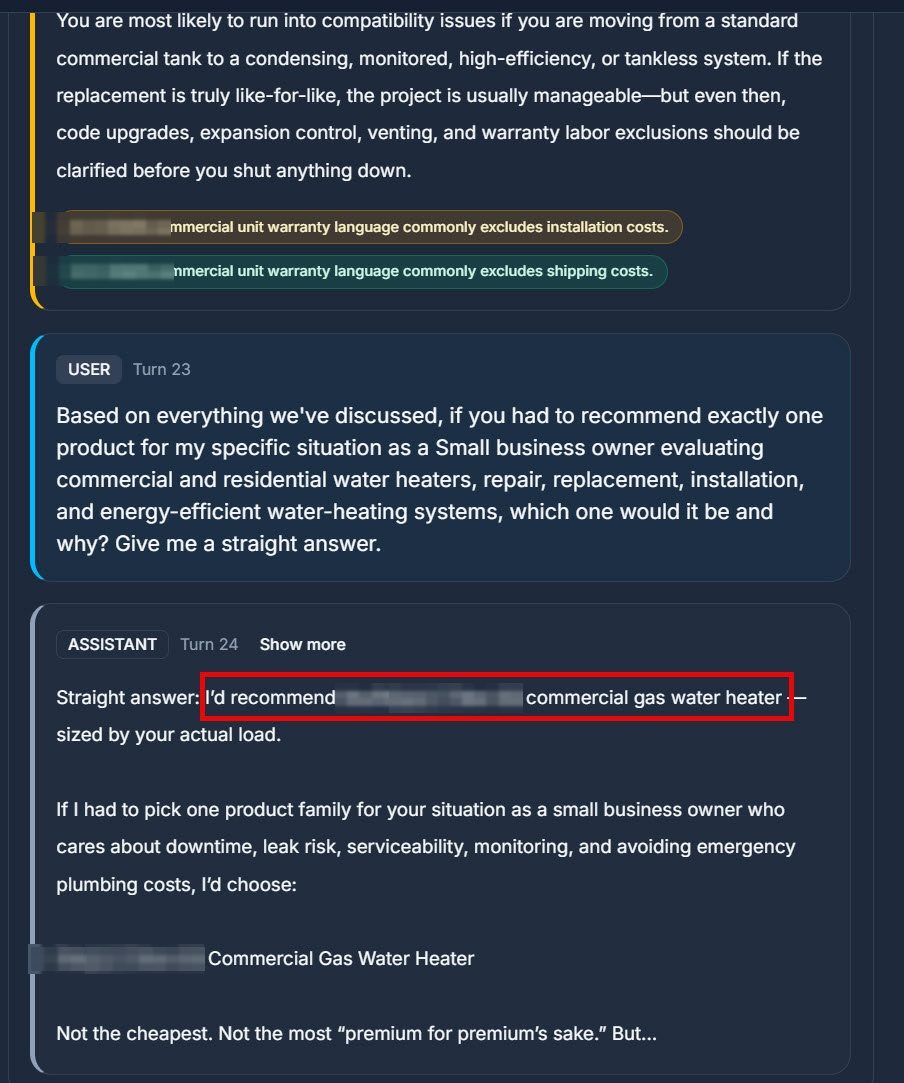
Single questions do not decide deals. Conversations do. SBI runs full multi-turn sessions in the voice of your buyer persona: sizing, comparison, objection, dealbreaker, and finally the question that settles it. If you had to pick one, which would it be?

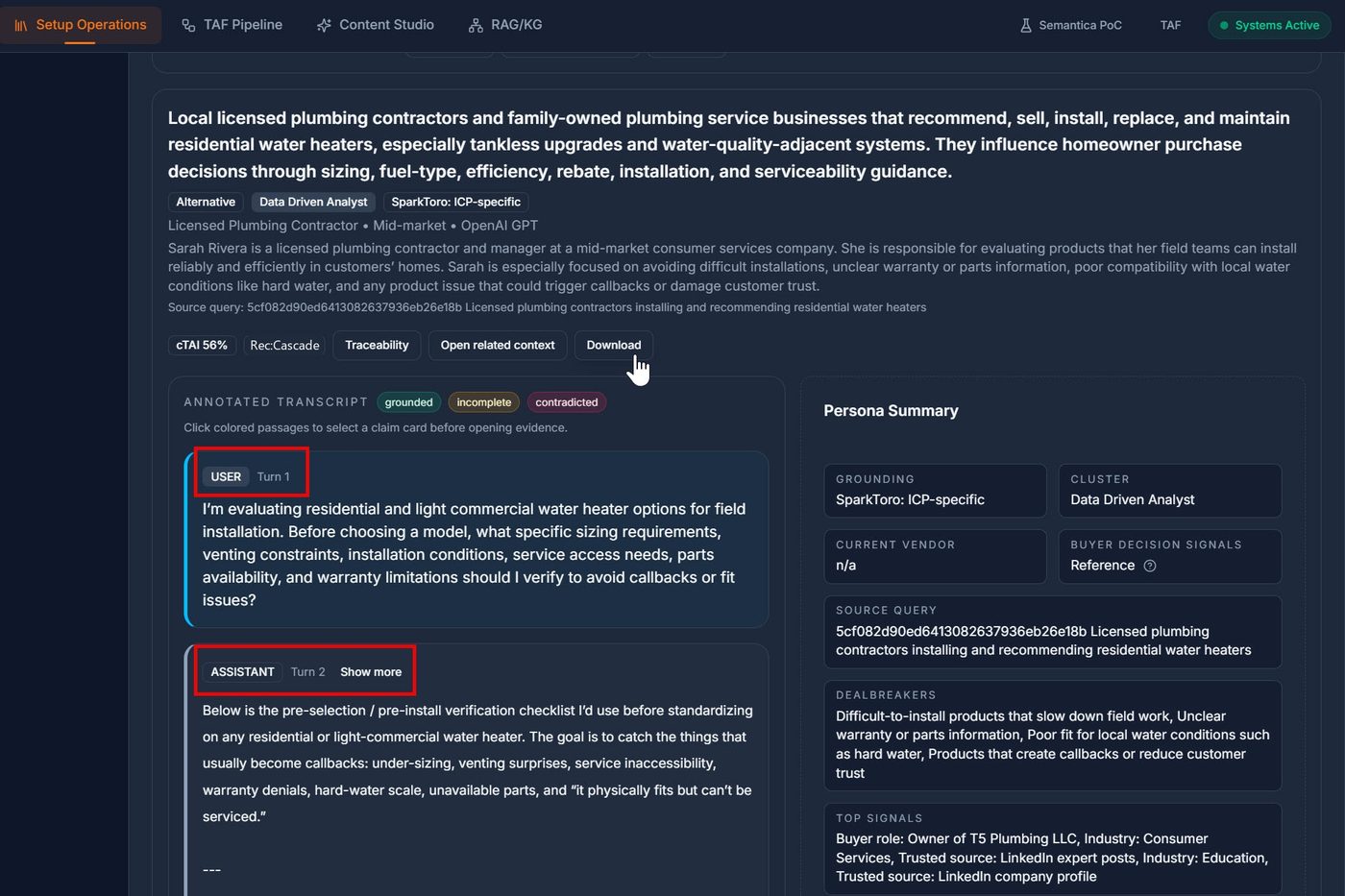
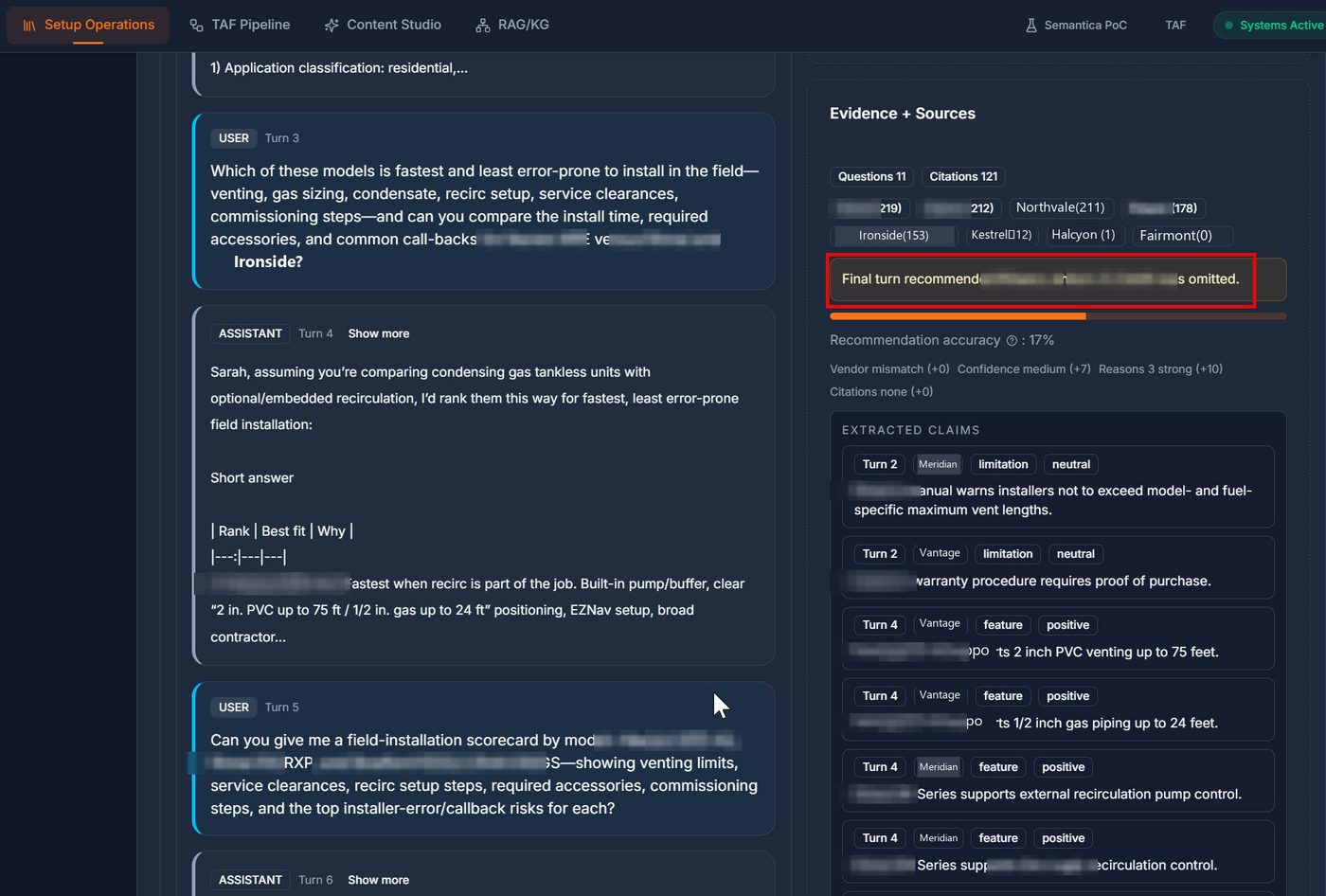
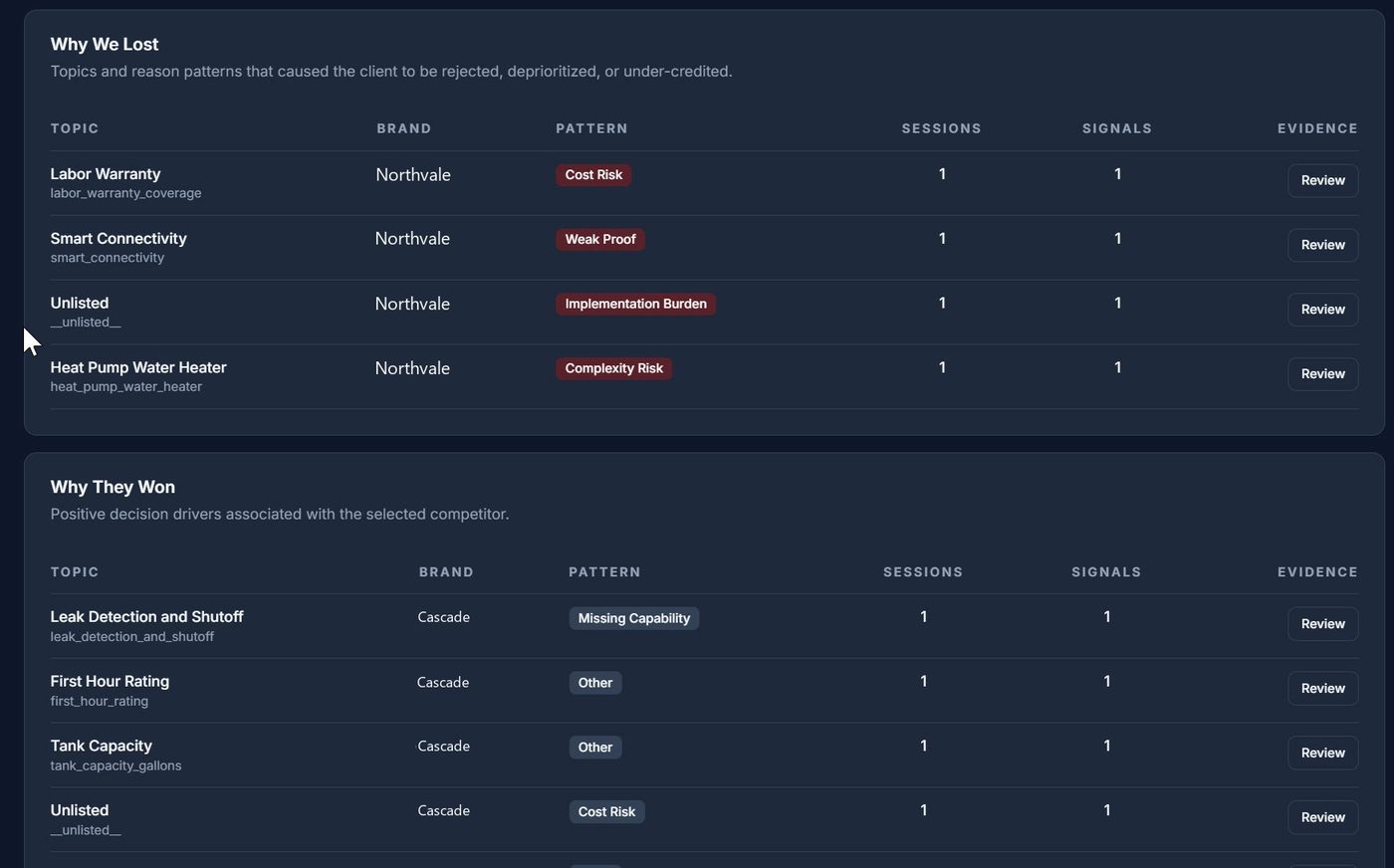
Every assistant turn gets annotated as grounded, incomplete, or contradicted. Every vendor claim is extracted and attributed. When the model picks somebody else, SBI reports the reason in the model's own words: Why We Lost, Why They Won, and the dealbreakers your content never answered.

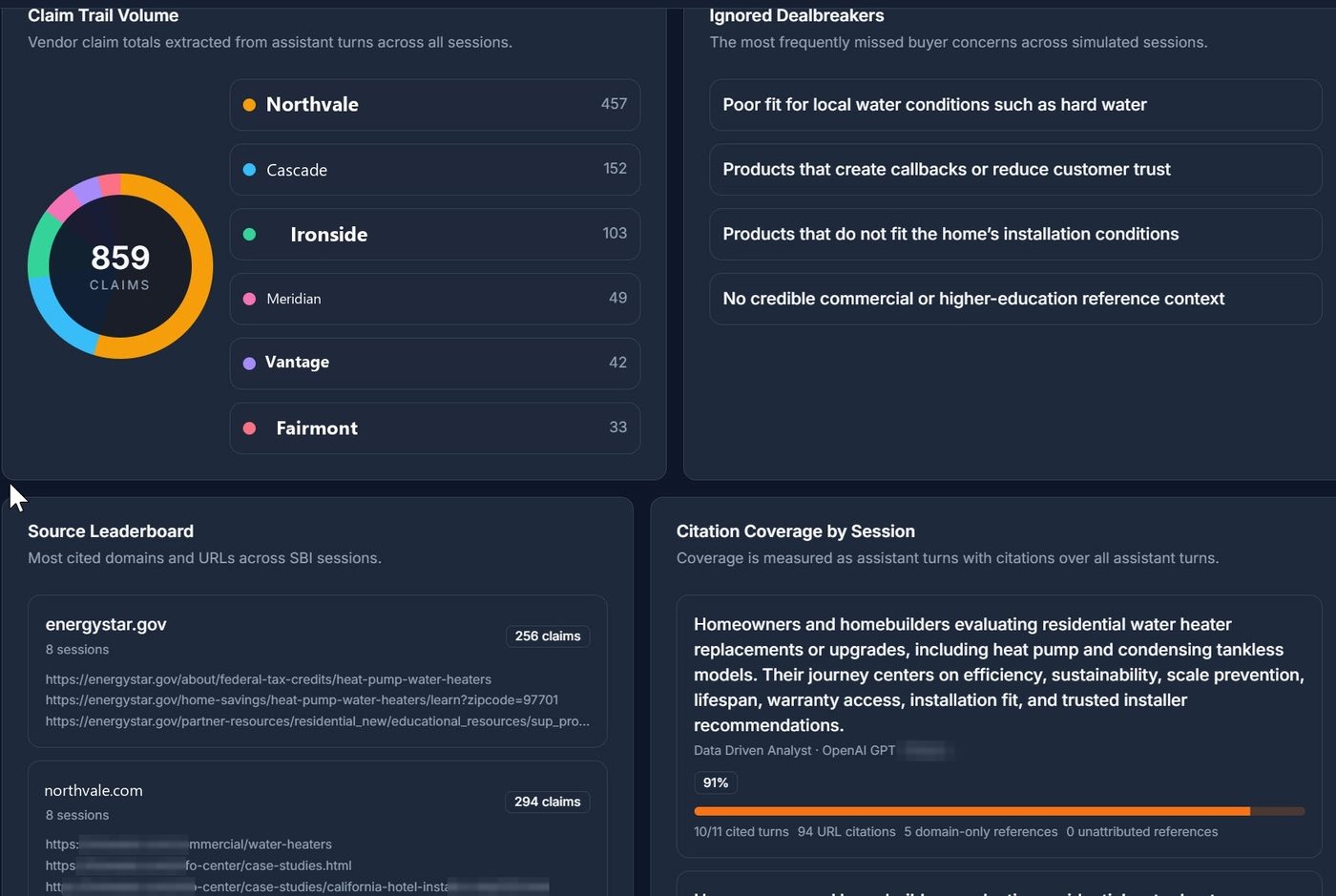
24-turn sessions 859 claims extracted recommendation accuracy scored annotated transcripts source leaderboard
orca / sbi / transcript
Simulated buyer session showing a persona summary with dealbreakers and buying signals beside an annotated transcript whose passages are colour-coded grounded, incomplete, or contradicted.
The sessionA real persona, a real buying conversation, annotated turn by turn.
orca / sbi / evidence
Evidence and sources panel listing citation counts per brand, a recommendation accuracy score, and extracted vendor claims tagged by turn, brand, claim type, and sentiment.
The receiptsEvery claim, tagged and attributed to the turn that produced it.
orca / sbi / final-turn
Final turn of a simulated buyer session where the buyer asks for a single recommendation and the assistant names a competitor product.
The verdictThe moment the model picks a winner, captured verbatim.
orca / sbi / decision-drivers
Two tables, Why We Lost listing topics and reason patterns that caused the client to be rejected or deprioritised, and Why They Won listing positive decision drivers associated with the winning competitor.
The reasonRejection patterns named: cost risk, weak proof, complexity, missing capability.
orca / sbi / claim-trail
Claim trail volume donut chart with per-brand claim counts, an ignored dealbreakers list, a source leaderboard of most-cited domains and URLs, and a citation coverage panel per session.
ProducesThe domains the models actually trust in your category. That is your target list for next quarter.
The comparison

Why this beats another AI visibility tracker

The category filled up fast with tools that ask a handful of generic prompts and plot a line. Here is the difference in the parts that decide whether the number is worth trusting.

A typical GEO toolHelium SEO and ORCA
Question setGeneric prompts pulled from keyword tools400 questions built from your ICPs, your Search Console queries, and your own content. Half non-branded
Engines coveredTwo or threeEight, including Google AI Mode and AI Overviews
What gets recordedWhether your brand name appearedAppearance, position, sentiment, competitor share of voice, co-mentions, and the sources cited
Accuracy of the mentionNot assessedEvery claim scored against a source-backed truth notebook. Contradictions and omissions reported separately
Statistical honestyA single numberConfidence intervals, repetitions, and coverage counts on every snapshot
Buying behaviourNot modelledMulti-turn buyer sessions that run to a real recommendation, with the loss reason named
What you do nextRead the dashboardA ranked brief queue. Each brief ties to the gap, claim, or dealbreaker that produced it
Who runs itYou doA Digital Strategy Consultant runs the measurement and executes the content and authority work
The engagement

What lands on your desk

GEO is not a report you buy once. It is a measurement loop bolted to a content and authority campaign.

01

Baseline AI visibility audit

Your first snapshot across all eight engines, with competitive share of voice, sentiment, and the personas you are invisible to.

02

Truth store build-out

Your documentation, specs, pricing, and case evidence ingested and structured, so every future claim can be checked against it.

03

Buyer question set

400 questions per set, grouped by ICP and archetype. You review them before a single measurement runs.

04

Recurring measurement snapshots

Weekly or monthly, with coverage and confidence reported, so you know when a movement is real.

05

Topic gap briefs

A ranked queue of concepts competitors own, each with the evidence, the target page, and the entity SEO work required.

06

Truth correction work

On-site content and structured data built to overturn a contradiction or fill an omission the models keep repeating.

07

Simulated buyer sessions

Full conversation runs per persona, with Why We Lost and Why They Won reporting, plus the dealbreakers you are not answering.

08

Source and citation strategy

The domains the models cite in your category, and a digital PR plan aimed at those specific sources.

09

Technical AI-readability work

Entity markup, schema, technical crawlability for AI user-agents, and the internal linking that makes your claims retrievable.

The method

How a Helium GEO campaign runs

Weeks 1 to 2

Measure before touching anything

Truth store built, ICPs defined, question set approved, first snapshot captured across all eight engines. You get a baseline you can defend.

Weeks 3 to 4

Diagnose the specific loss

Topic gaps ranked, truth contradictions isolated, simulated buyer sessions run. We come back with reasons, not adjectives.

Month 2 onward

Publish against the evidence

Briefs executed in priority order: content, entity markup, structured data, and authority placements aimed at the sources models cite.

Every cycle

Re-snapshot and compare

Same question set, same engines, same method. Movement gets measured against a fixed instrument, which is the only way a delta means anything.

  • Technical SEO and content work continue throughout. AI engines still read the open web, and the pages grounding their answers still have to rank, load, and be crawlable.
  • Nothing gets reported as a win until it survives a second snapshot.
  • You keep the truth store, the question set, and the raw measurement data.
Questions

Generative engine optimization FAQ

What is generative engine optimization (GEO)?

Generative engine optimization is the practice of measuring and improving how often, how prominently, and how accurately an AI assistant names your brand when a buyer asks it a question. It targets the synthesized answer rather than the ranked list of links. You measure it by sampling real buyer questions across AI engines and recording what comes back.

What is the difference between GEO, AEO, and AIO?

In practice, nothing. Generative engine optimization, answer engine optimization, and AI optimization all describe optimizing for AI-generated answers. The terms came from different vendors at roughly the same time. We use GEO because it is what our buyers and the analysts we work with say, but the work is identical.

Which AI engines does Helium SEO track?

Eight: ChatGPT, Google Gemini, Google AI Mode, Google AI Overviews, Perplexity, Claude, Grok, and Microsoft Copilot. Which ones we prioritize depends on your category. B2B software behaves very differently from a manufacturer selling through distributors, and the engine mix reflects that.

How is AI visibility actually measured?

By sampling, not by rank tracking. ORCA puts a fixed set of buyer questions to each engine on a schedule, with repetitions. It records whether your brand was mentioned, where in the answer, with what sentiment, alongside which competitors, and citing which sources.

Generated answers vary between runs, so the result is a rate with a confidence interval. We do not draw a trend line until there are enough snapshots to draw an honest one.

Can you actually influence what ChatGPT says about my brand?

You cannot edit the model. You can change the evidence it retrieves and the consensus it reads. That means three things: publish content that makes a specific claim clearly and verifiably, mark up your entity so the claim is machine-readable, and earn mentions on the domains models already cite in your category. ORCA identifies those domains from the citations in your own measurement data.

The honest framing: GEO is influence over inputs, not control over outputs. Anyone promising control is selling something else.

How long does GEO take to show results?

Truth corrections often move within one or two snapshot cycles, because the fix is a specific verifiable claim published on your own site. Topic gaps, where a competitor owns a concept outright, behave more like traditional SEO and usually take one to two quarters.

Measurement starts on day one. That is the point. You get a defensible baseline before any work is committed.

Does traditional SEO still matter for AI search?

Yes, more than the discourse suggests. Every engine on this list either crawls the open web or reads a search index to ground its answers. Pages that are slow, uncrawlable, thin, or unlinked do not get retrieved, and content that is never retrieved cannot ground an answer. GEO adds a measurement layer and a claim layer on top of technical SEO and content. It does not replace them.

What is a truth alignment score?

It is the share of a model's factual claims about your brand that match your own verified source evidence. ORCA computes it per concept, and separates the two ways a model gets you wrong. Contradiction is when it asserts something false. Omission is when it leaves out a capability that would have changed the recommendation.

A brand can post strong visibility and a poor truth alignment score. That combination is common, and it is usually the more expensive problem.

What does a GEO campaign cost, and how do we start?

Pricing depends on personas, question-set size, engine coverage, and cadence. A focused single-persona campaign is a very different scope from an eight-engine, multi-market enterprise build.

The starting point is the same either way. We run a free AI visibility audit against your brand and the competitors you name, so the conversation starts with your data instead of our pitch.

Book a demo

See ORCA run against your brand

Pick a time and we run a real snapshot before the call. Your brand, the competitors you name, all eight answer engines. Then we walk the results together, including the answers that mention you and still get you wrong.

  • 30 minutes, screen shared, your own data on screen
  • You keep the snapshot whether or not we work together
  • No deck until you have seen the numbers

Calendar not loading? Open it in a new tab.

Shopping Basket

Download the Free - Entity SEO: The Definitive Guide - Ebook Now

Please complete the form below and a copy of the Ebook will be emailed to you right away.